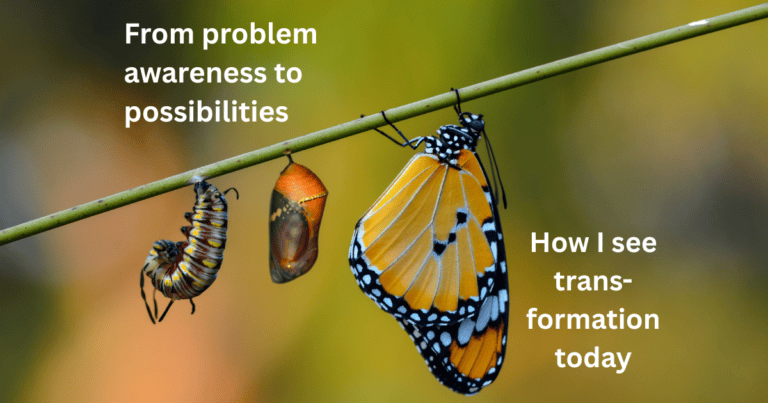
The past three months have been intense and deeply inspiring. I’ve taken part in several meaningful events and worked with three hotels and regions, applying a regenerative, systemic approach. Living a nomadic life during this time brought me into contact with amazing people. Together, we reflected on these experiences—an exchange that sparked a significant shift in how I see the world and how I want to work moving forward.
Looking for a way to describe the times we’re living in, one phrase keeps coming to mind: sensing into the new and letting go of the old. We are living in times of profound change. That change can be unsettling, and many people respond with fear or denial. But by doing so, we distance ourselves from reality—and from our ability to act. As Otto Scharmer puts it: we are collectively creating a future that no one wants.
From Ego to Eco
One of my biggest learnings over the past months is that I shifted from seeing the world through a single, personal lens to understanding it from a collective, systemic perspective. For example, at the #IDGCaux event, I was one of 200 people exploring the inner dimensions of change. In every conversation, I felt like the whole system was speaking through one person. One powerful exchange was with a woman from South Sudan. For her, climate change isn’t just about unusual weather; it’s about survival. With temperatures reaching over 55°C and rising water levels, parts of her homeland are becoming uninhabitable. Still, her tribe finds pride in creating their own solutions. But the message is clear: we are all responsible for climate-driven migration, and it’s not a future issue—it’s happening now.
Another insight: the quietest voices often hold the deepest wisdom. Whether in a partnership, organization, or society, these voices often sense what’s emerging in a system. In one hotel training, a participant challenged the direction of our work. My first reaction was to dismiss it. But as I relaxed into the moment, I realized their words revealed something I hadn’t seen. I opened the conversation to the group, and we uncovered shared feelings of hopelessness and not belonging. Only by giving space to those feelings were we able to move through them—together. This helped us reach a new level of connection. My role as a facilitator wasn’t to fix it but to hold space, even when I felt challenged myself.
We need a new dynamic of change
Another powerful realization—and my greatest hope—is that working systemically is far more dynamic than any approach I’ve known. In this way of working, we don’t “fix” problems. We sense where energy flows and where it doesn’t. We look for leverage points that can uplift the whole system. It’s not about being the expert or giving answers. It’s about helping the system see itself more clearly—because every system, like nature, wants to regenerate.
In one team I worked with, two people weren’t speaking to each other. It affected the entire organization. When they realized how their relationship influenced the whole system, something shifted. Their reconnection sparked a wave of new energy and aliveness in the group.
I saw the full power of this systemic work during a five-day gathering with seven people. Our intention was to become radically alive. We listened deeply to each other, supported each other, and worked through personal blockages together. It all happened simultaneously, in real time. By the end, we didn’t even need to talk anymore. We were in flow. It felt like a superorganism—like a beehive or an ant colony—each part alive and connected to the whole.
(photo: Olivia Chollet, babyPRO)

Andreas Koch, a leading expert in sustainable and regenerative tourism, has dedicated over 25 years to integrating sustainability as a model for success. As Sustainability and Quality Manager at TUI Germany, as well as the founder of bluecontec/tourythm GmbH and Futouris e.V., he has supported numerous destinations and hotels. Koch views sustainability as a fundamental mindset and advocates for collaborative, interconnected approaches to build a future-ready industry.